Primary Line Showcase (Batch I)
Engineered Rotary Cutting Tools & Carbide Components
Direct-from-factory rotary discs, high-precision slitting blades, and wear-resistant end mills sintered from submicron powders to guarantee runout tolerances below ±0.003 mm.
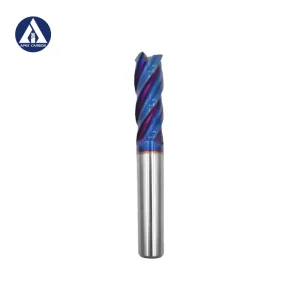
China 65 HRC Tungsten Solid Carbide Milling Cutters with NaNo Blue coating
View Specs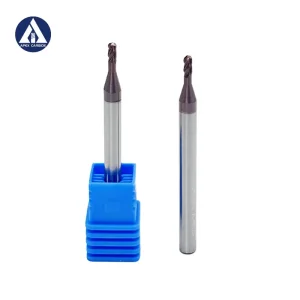
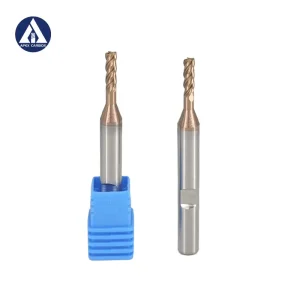
China Long Neck Ball Nose Carbide End Mills with TiALN Coating
View Specs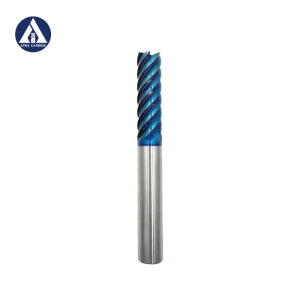
Wholesale Flat End Mill 6 Flutes Straight Shank with NaNo Blue Coating
View Specs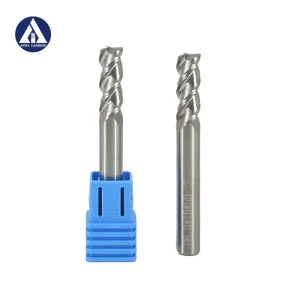
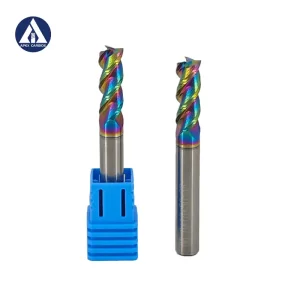
China Solid Carbide End Mills for Aluminium with Polished/High Gloss
View Specs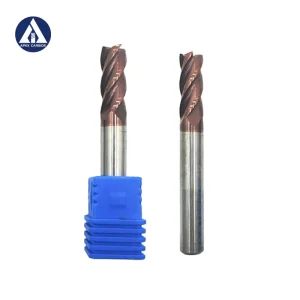
China 50 HRC Flat Carbide End Mills with TiAlN Coated Manufacturer, Factories
View Specs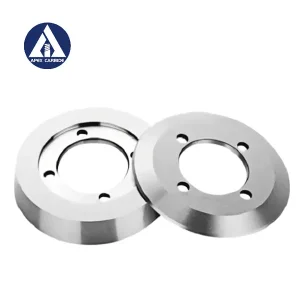
China Tungsten Carbide Circular Cutters Blades Manufacturer, Suppliers
View Specs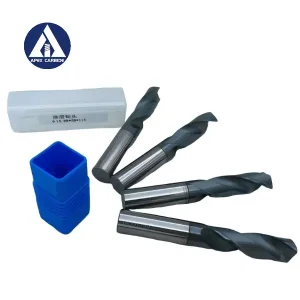
Wholesale Tungsten Solid Carbide Drills with Coated Customized Tools
View SpecsRa ≤ 0.05
Mirror Surface Finish (μm)
±0.002 mm
Axial & Radial Runout Limit
10-15x
Life Multiplier vs High Speed Steel
1,000,000
Monthly Tool Production Capacity
Commercial & Industrial Status
The Global Industrial Landscape for Circular Slitting Cutters
Continuous roll-to-roll manufacturing, ultra-thin battery foils, and high-speed flexible packaging require rotary slitting blades that eliminate micro-burrs and resist extreme abrasive wear.
Battery Electrode Foil Slitting
In lithium-ion and solid-state battery gigafactories, copper anode and aluminum cathode web slitting demand zero edge burring (<5 μm). Sinter-HIP carbide circular slitters eliminate edge tears that trigger internal short-circuits during cell winding.
Non-Ferrous Precision Strip Slitting
Strip processors slitting electrical silicon steels, beryllium copper, and titanium foils operate under continuous tensile stress. Tungsten carbide rotary shear knives maintain tight lateral clearance without galling, delivering burr-free slitting across millions of continuous meters.
High-Speed Flexible Packaging & Film
BOPET, BOPP, and multi-layer barrier films run through high-speed rewinder machines at up to 1,200 m/min. Submicron circular slitting discs with mirror-polished bevels avoid poly dust buildup and prevent heat deformation that causes web breakage.
Emerging Engineering Vectors
Market Trends & Submicron Metallurgy Drivers
Circular cutter life and edge geometry are governed by carbide binder composition, WC grain homogeneity, and advanced physical vapor deposition (PVD) coatings.
Submicron Grain Structuring
Transitioning from 1.2 μm medium grain to 0.4–0.6 μm ultrafine tungsten carbide crystals increases transverse rupture strength (TRS) past 4,000 MPa, preventing micro-chipping under cyclic edge pressure.
DLC & CrN PVD Coatings
Diamond-Like Carbon (DLC) films lower the friction coefficient to 0.08, preventing adhesive wear when slitting glued composites, label stock, and gummy multi-layer barrier polymers.
Total Cost of Ownership (TCO)
While solid carbide blades cost more than tool steel up front, their 10x to 15x regrinding intervals dramatically cut line downtime and knife changeover hours on continuous slitting lines.
Optical Vision Slit Quality Control
Integrated slitting lines now pair with real-time laser diffraction sensors. Blades must hold radial runout within 0.002 mm to prevent high-frequency vibration marks on fast-moving webs.
| Carbide Grade Matrix | Cobalt Binder (%) | Grain Size (μm) | Hardness (HRA) | TRS (MPa) | Primary Industrial Application |
|---|---|---|---|---|---|
| APEX-U06 (Ultra-Fine) | 6.0% Co | 0.4 – 0.6 | 93.5 | 3,800 | Lithium battery foil slitting, electronic copper foil, cleanroom film |
| APEX-M08 (Submicron) | 8.0% Co | 0.6 – 0.8 | 92.4 | 4,100 | High-speed paper converting, multi-layer laminated pouch packaging |
| APEX-G10 (Toughness Plus) | 10.0% Co | 0.8 – 1.0 | 91.2 | 4,300 | Heavy-gauge metal coil slitting, corrugated board, abrasive textiles |
| APEX-CR12 (Corrosion Resist) | 12.0% Ni/Cr | 0.8 – 1.2 | 90.5 | 3,600 | Wet-environment chemical processing, acidic food wrap converting |
System Engineering & Future Outlook
Macro Solutions & Factory Technical Roadmap
We deliver balanced shear pairs, pneumatic holders, and cryogenic metallurgical treatments to maximize cutting stability across converting machinery worldwide.
Top & Bottom Shear Matching
Slitting precision relies on harmonious tool pairing. We manufacture synchronized male and female circular slitters with matched edge angles and calibrated chamfers to avoid shear deformation, edge wave, and burr formation.
Deep Cryogenic Quenching
Our 2026-2028 process roadmap introduces liquid nitrogen conditioning (-196°C) following Sinter-HIP densification. This treatment eliminates residual cobalt binder stresses, boosting micro-chipping resistance by an extra 35%.
Cleanroom Ultraclean Surface Polish
Battery electrode and optical film converting lines cannot tolerate particulate shedding. Our multi-stage diamond wheel lapping delivers an Ra 0.05 μm mirror finish, keeping tool faces free of carbon debris and metallic dust.
Procurement & Technical FAQ
Frequently Asked Questions for Sourcing Directors
Practical engineering answers covering minimum order quantities, regrinding support, runout tolerances, and custom OEM manufacturing.
What tolerances do your circular slitting cutters maintain?
Our CNC grinding lines routinely hold thickness tolerances within ±0.001 mm and outer diameter tolerances to ±0.005 mm. For critical battery electrode lines, we grind axial runout within ±0.002 mm to prevent flutter and edge burrs at high line speeds.
How do you stop carbide slitter blades from micro-chipping?
Micro-chipping usually stems from residual voids, improper cutting angles, or uncompensated spindle runout. We run 100% of our blanks through low-pressure Sinter-HIP furnaces to eliminate internal micro-pores, then prep the cutting edge with a controlled 2–5 μm radius hone that strengthens the cutting wedge without raising shear resistance.
What is your standard MOQ and production lead time?
Standard stock sizes start from 1 piece for sample testing. Custom sizes, non-standard keyways, and special edge angles ship within 7 to 25 business days, supported by our 3 Jiangxi manufacturing facilities and 500+ on-site personnel.
Can tungsten carbide slitter knives be reground cost-effectively?
Yes. Depending on edge wear depth, our solid carbide slitting cutters can typically be reground 8 to 12 times on high-precision diamond grinding equipment. Re-lapping both outer faces and the bevel restores original cutting geometry at a fraction of new blade cost.
Which carbide grade works best for lithium foil slitting?
We recommend submicron or ultrafine grain tungsten carbide (0.4–0.6 μm) with 6% to 8% cobalt binder, such as APEX-U06. This formulation delivers extreme hardness (93.0–93.8 HRA) paired with high compressive strength, keeping cutting edges sharp across continuous high-speed runs.
Do you manufacture custom blades from OEM engineering prints?
Over 60% of our production runs to customer drawing. Our tooling engineers review your CAD drawings (DWG, STEP, PDF) to select optimal carbide compositions, blade bevel geometries, and surface polish specs tailored to your slitter machinery.
Extended Tooling Solutions (Batch II)
Solid Rod Blanks, Coolant Tools & Chamfer End Mills
Precision-ground solid rod blanks, coolant-fed drills, and specialty profile end mills manufactured with integrated quality controls from powder prep through Sinter-HIP processing.
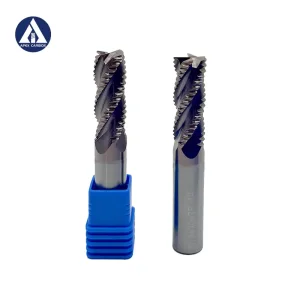
China 4 Flute Straight Shank Carbide Roughing End Mill with TiALN Coating
View Specs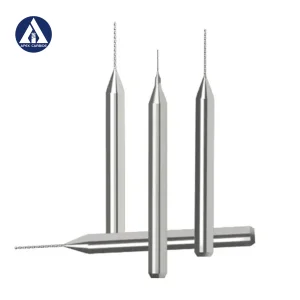
Ultra Fine Grain Carbide Rod Blanks For PCB Micro Drill Bit Manufacturing
View Specs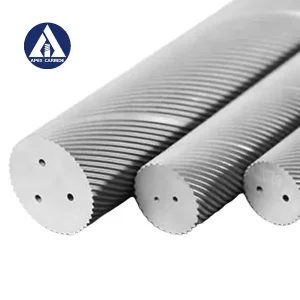
Factory Supply Tungsten Carbide Rods with Two Helix Holes (30°/40°)
View Specs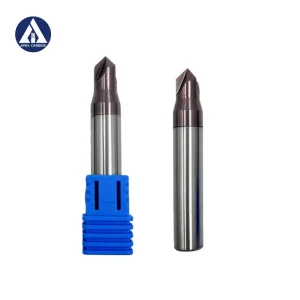
Wholesale 90° 3 Flute Carbide Center Chamfer End Mill Suppliers
View Specs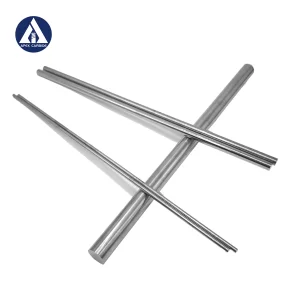
Solid Carbide Blank Rod Cut to Length for End Mill Manufacturing
View Specs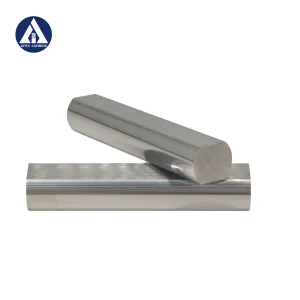
Carbide Round Blank with Two Weldon Flats, Pre-Ground for Tooling
View Specs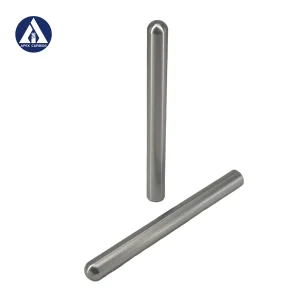
Carbide Preformed Ball Nose Blank Rods with Pre-Machined Sphere Tip
View Specs